Be yourself; Everyone else is already taken.
— Oscar Wilde.
This is the first post on my new blog. I’m just getting this new blog going, so stay tuned for more. Subscribe below to get notified when I post new updates.
Be yourself; Everyone else is already taken.
— Oscar Wilde.
This is the first post on my new blog. I’m just getting this new blog going, so stay tuned for more. Subscribe below to get notified when I post new updates.
With 1 in 8 women being diagnosed with breast cancer, it is very likely that we all know someone, or have been affected ourselves, by this disease. It is currently the leading cause of death of women in the United States [1]. With statistics as daunting as these, the need for better treatment to eradicate the disease is ever-present. Current treatment options are limited, with major treatments being chemotherapy, hormone therapy, or surgical therapy in the form of a mastectomy. Treatment options shrink even more when considering the different breast cancer subtypes. One of these subtypes is triple-negative breast cancer (TNBC). For a better understanding in how this subtype differs from normal breast cancer, I am going to provide a quick explanation.
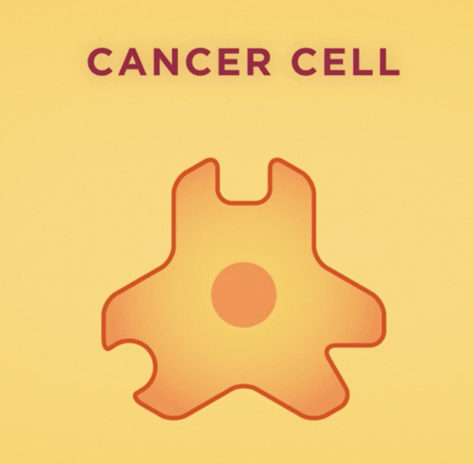
A normal cancer cells growth is fueled by three main hormones: estrogen, progesterone, and hormone epidermal growth factor receptor 2 (HER-2) [2]. As seen in the figure below, a cancer cell has specific notches, or receptors, unique to each of these hormones. In a treatment such a hormone therapy, the therapy can specifically target these receptors and interfere with the binding of hormones; therefore, limiting the growth of the cell.
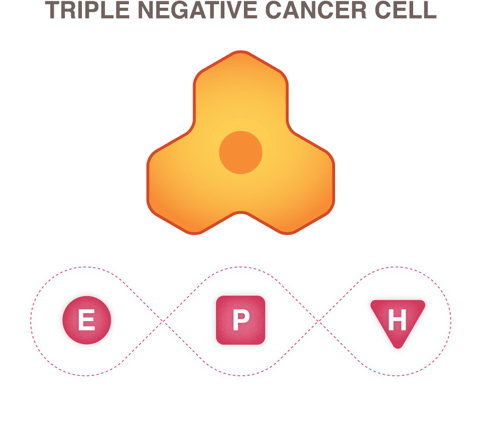
However, in the case of triple-negative breast cancer, these cancer cells lack those receptors for the hormones. This means that the cancer cell is growing because of some other source. A good way to picture this is seen below. As you can see, the cell does not have the same notches (receptors) that a normal cell has present. This also limits treatment options. This means that the patient cannot undergo hormone therapy of any kind, because the cell is insensitive to it due to the lack of receptors [3]. There simply is not a target!
Not only is there a lack of treatment options, triple-negative breast cancer is a much more aggressive form of cancer. It quickly spreads to other parts of the body and metastasizes. The prognosis is rarely good, and relapse/recurrence rates are significantly higher than in normal breast cancer types. For this reason, there is an area of research needed that focuses primarily on triple-negative breast cancer. After studying the research that is already out there, I felt that I wanted to contribute my own research plan, utilizing my specialty in genetics and genomics, to provide more options for patients with this diagnosis.
Gene therapy is a new form of treatment in clinical trials that utilizes personal genomics to identify where the “bad” genes are that are either not working properly, or are working a little too well. This technique basically uses a virus or other cellular device to transport a “good” gene and replace the bad one. Below you can view a video from the US FDA that breaks this process down into non-science terms that is a great summary of what is happening [4]! Once you get a good understanding of that, pick up reading “The Research Concept.” ☺
Gene therapy is full of potential and is a prospective life changing medical treatment. It could quite literally change the way that we treat every patient, starting with a focus at the genomic level to discover the exact problem unique to that individual. I felt that utilizing gene therapy to target TNBC tumors would be a viable option to eradicate the disease. To do this, I propose the use of testing the actual tumor tissue, as well as testing normal tissue in the patient, to identify the cause of the TNBC. With the fuel behind the cell growth in this cancer type being so variable from patient to patient, it is essential to look at it on a genomic level. In doing this, a target can be identified. Next, the utilization of gene therapy would ensue. The use of very tiny particles as the “vehicle” to transport the good DNA to the cell is the most ideal way of implementing this treatment. Once the good DNA is inserted into the cell, it would match with the bad DNA and replace it. This results in a change in the genetic code, or the direction manual for the cell, to stop the growth of the cancer cell and what is causing the growth of the cell. This could also induce cell death of the cancer cells that are bad, and change the bad DNA in the cells that have not yet started to grow at an abnormal rate.
So why even go through all of this research process? Because it matters. In this case, the benefits of finding a cure far outweigh the costs that are needed in a 1,000,00:1 ratio. Too many lives are taken every day because normal cells are reprogrammed over the course of life to turn to the bad side, resulting in bad cells that cause cancer. With so many people in the population being touched by this disease, there is no longer a question of why this needs to be done, it is now how. How can we eliminate breast cancer for good? How can we make sure that mothers grow old and are able to see their children grow up? How can we promise to that grandmother that she will be able to one day see her grandchildren be born? The answers that this research can provide is all about keeping families together. The possibilities of answers to these questions gives hope to so many who have nothing left to hold onto.
As social media continues to expand in popularity, there becomes a need to research what people are viewing, why they view it, and how they interpret it. This is especially important to understand in the scientific community, as the sources used for obtaining information could very well be illegitimate and /or publishing incorrect/misleading data. “The Science People See on Social Media” presented extensive research on what platforms are used and engaged with the most, as well as what these science-related Facebook accounts are posting about the most. Shockingly, they discovered that 33% of all social media users that view these science-related accounts rely on them as an important source for learning about science news. WHAT? I understand that this is the most accessible option, but Facebook as a primary source for science news seems odd. Moreover, to be considered a source for new science news, there aren’t many “new science discovery posts” being made on these accounts. Across 30 of the most popular scientific Facebook pages, only 29% of these posts actually presented new discoveries. If the daily news program presented less than a third of the breaking news occurring in the neighborhood, no viewer would consider that a reliable source for obtaining information. After learning how many people rely on these pages for their science news, it continues to raise red flags when the research shows the breakdown of post percentages by topic. Most of the pages do not touch on major scientific topics that are controversial and are some of the most important that need to be discussed. On many pages, there is no mention of climate change, vaccines or GMOs. If many of the main topics that need to be discussed are not even mentioned, how is the public getting going to get informed on these important issues? In terms of engagement activity with these posts, research found that people tend to be more drawn to posts with a visual component. This is not out of the ordinary, as many people do relate more to a topic when a visual is provided. However, research also found that some of these higher engagement visuals included simply a picture with fruit saying: “Share if you think all schools should have this.” That is it. That’s the post. Shocking, I know. The summary of this article is that the way in which people are obtaining what they think is groundbreaking scientific news is completely and utterly sad.
The next article puts the focus on the writer with a look at how to present scientific information online. It first outlines the different platforms and the audiences that typically utilize them, as well as the purpose that they serve. For example, a website tends to be a more credible source than an informal blog posting. Moreover, a website allows you to write in detail with more depth to the writing whereas a social media post does not allow this. The article also elaborates on the engagement variations. On social media, you can readily converse with people who leave comments. The process is much slower if someone reads your article on a website, and then proceeds to email you. After choosing a platform, you then have to consider how to brand yourself and the strategies to use in order to get the message to a massive amount of people. Two of the suggestions I found to be important were conversations and sharing ability. Ensuring that you are conversing with those who read your work is essential. Different platforms allow different dynamics of communication. Using one in which conversation can keep at an active pace is important. Moreover, the ability to share the post ensures that it gets into the hands (or on the screens) of many more people.
I chose to follow Molly Grantham on Twitter. She is a local news personality and a huge advocate for breast cancer as her mom recently passed from it. She has 16,100 followers. She runs her own account and it was created in January of 2012. Most of her posts are not scientific related with several visual postings spread every few posts. She is the founder of Molly’s kids: children and young adults with terminal or debilitating illnesses that she highlights and brings awareness to their story. These posts receive the most engagement by far. She definitely utilizes the ability to post pictures to go along with her stories, bringing more attention to them when you see the face of someone alongside a terribly sad news story. I think that she could break up her postings some and add more of a relationship element with her followers, but she is good about replying to relevant comments so it is not a huge necessity.
This is an example post, originally published as part of Blogging University. Enroll in one of our ten programs, and start your blog right.
You’re going to publish a post today. Don’t worry about how your blog looks. Don’t worry if you haven’t given it a name yet, or you’re feeling overwhelmed. Just click the “New Post” button, and tell us why you’re here.
Why do this?
The post can be short or long, a personal intro to your life or a bloggy mission statement, a manifesto for the future or a simple outline of your the types of things you hope to publish.
To help you get started, here are a few questions:
You’re not locked into any of this; one of the wonderful things about blogs is how they constantly evolve as we learn, grow, and interact with one another — but it’s good to know where and why you started, and articulating your goals may just give you a few other post ideas.
Can’t think how to get started? Just write the first thing that pops into your head. Anne Lamott, author of a book on writing we love, says that you need to give yourself permission to write a “crappy first draft”. Anne makes a great point — just start writing, and worry about editing it later.
When you’re ready to publish, give your post three to five tags that describe your blog’s focus — writing, photography, fiction, parenting, food, cars, movies, sports, whatever. These tags will help others who care about your topics find you in the Reader. Make sure one of the tags is “zerotohero,” so other new bloggers can find you, too.
 Taylor's Blog